Autopilot (AFCS)
The E3X reproduces the real unit’s automatic flight control system: the mode logic, the annunciations, and the flight director are all computed by the E3X itself, then coupled to whatever autopilot your aircraft actually has.
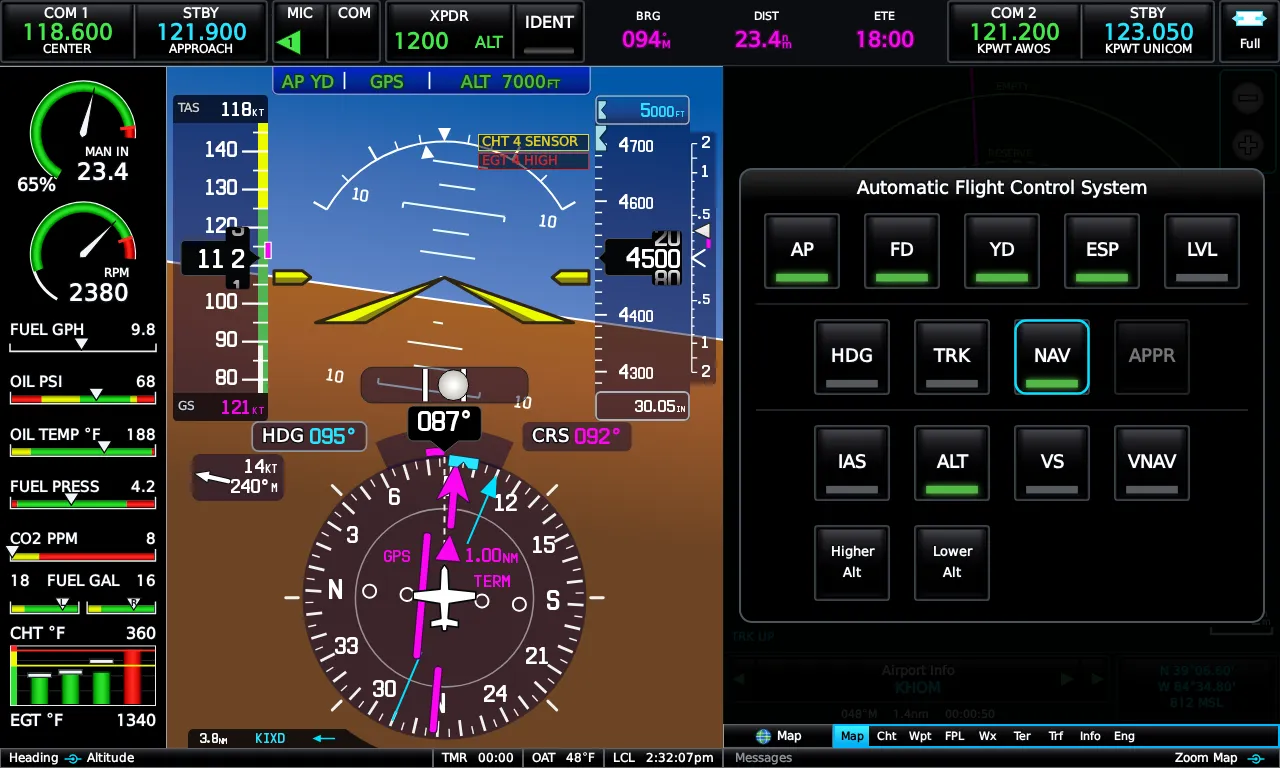
The AFCS window
Section titled “The AFCS window”Touch the AFCS status box at the top of the PFD — or open Main Menu → Flight Controls — for the Automatic Flight Control System window. The button grid matches the real unit’s controller:
- AP · FD · YD · ESP · LVL
- HDG · TRK · NAV · APPR
- IAS · ALT · VS · VNAV
- A context pair below: Nose Up / Nose Down in pitch and VS modes, Slower / Faster in IAS mode, Higher Alt / Lower Alt in altitude hold — each press one real-unit increment (0.5°, 100 fpm, 1 kt, 10 ft).
Keys that can’t do anything right now — NAV with no usable source, VNAV with no profile — render grey. Pressing an active mode’s key reverts that axis to its default (roll or pitch hold), and LVL cancels everything and rolls the wings level.
- Lateral: roll hold, HDG, TRK, NAV — which annunciates its actual source: GPS, VOR, LOC, or back-course — plus approach, go-around, and level modes. GPS steering flies the flight plan’s turns without chasing a heading bug.
- Vertical: pitch hold, ALT with selected-altitude capture (ALTS), VS, IAS, VNAV with target-altitude capture (ALTV), glideslope and glidepath, go-around, and level.
VNAV works the way the book says: the VNAV key arms, the descent leg captures it, the appropriate altitude capture arms beneath it, and the autopilot levels at the VNAV target — which becomes the new altitude reference, independent of the selected altitude.
Annunciations
Section titled “Annunciations”The AFCS status box across the top of the PFD shows active modes in green, armed modes in white; a capture flashes green for ten seconds. Losing the data behind a mode reverts that axis with a yellow flash. An autopilot disconnect flashes yellow (manual) or red (automatic) until you acknowledge it — touch the annunciation or the AP key. All alerting is visual.
ESP — electronic stability protection, on the GFC 500-class configuration — arms in the background, nudges the flight director at the edges of the attitude envelope, and engages the autopilot in LVL if the excursion persists.
Coupling to your aircraft’s autopilot
Section titled “Coupling to your aircraft’s autopilot”The E3X doesn’t replace your aircraft’s autopilot — it drives it, the way the real unit does, and it adapts to what that autopilot can do:
- Capable autopilots — a G1000 or GFC 500-class AFCS — are driven in their own native modes: the E3X commands the aircraft’s actual heading, altitude hold, and speed modes, auto-detecting what the AP honors (an airframe profile can also pin the answer).
- Legacy autopilots get precise flight-director control of heading and vertical speed instead.
Either way, every mode only the E3X computes — VNAV, GPS steering, glidepath, go-around, level — works, because the E3X’s flight director does the thinking and the aircraft’s autopilot does the flying. Native coupling applies to the X-Plane integration; on the experimental MSFS path the E3X flies the direct heading/VS method.
Emrelia E3X is an independent product of Emrelia LLC. It is not affiliated with, endorsed by, or sponsored by Garmin Ltd. or its affiliates. G3X Touch™ is a trademark of Garmin Ltd. For flight simulation use only — not for use in real-world navigation. Map imagery contains data © OpenStreetMap contributors (ODbL) and other sources — see data attributions. © 2026 Emrelia LLC.